Saturday, November 22, 2025

English Dominance, AI Bias, & Australia's Capability Crisis:

The following discussion points were shared with me by Mr Sherman Mak, an Innovation Programmes mentor/coach.in CSIRO — the Commonwealth Scientific and Industrial Research Organisation, Australia’s national science agency. CSIRO is widely regarded as one of the world’s most diverse and impactful research institutions, delivering cutting-edge science and innovative solutions for industry, society, and the environment. I found Sherman’s observations thought-provoking, and I have obtained his permission to reproduce them below.

Sherman is the scion of the Malaysia–Singapore Fung Keong Rubber Manufactory family. His wife, Lyn, is the Deputy Vice-Chancellor of Federation University Australia (formerly the University of Ballarat).


English Dominance, AI Bias, & Australia's Capability Crisis

1. The Core Problem: English Dominance can Stifle Innovation and Embeds Bias

Language is Power: English dominance worldwide creates linguistic imperialism and carries a cultural bias, favouring Western/American worldviews.

AI Bias as Reinforcement: Artificial Intelligence (AI) models (like Large Language Models or LLMs) are primarily trained on the vast amount of English data scraped from the internet. This causes AI to amplify the dominance of English and its embedded biases.

The AI Bias Problem: This results in AI systems that perform worse for non-native English speakers (e.g., scoring errors on essays, misinterpreting non-standard accents) and generate information that prioritizes American-centric perspectives, ignoring or distorting narratives from lower-resource languages.

Media English Language Bias Example (BBC): Even major news sources use loaded language (e.g., calling one group a "militant" while others are "terrorists") and biased framing, which subtly dictates global narratives.

Stifled Innovation and Talent: The English requirement blocks diverse global talent and unique cognitive frameworks embedded in other languages and systems. This lack of perspective diversity stifles innovation and creative problem-solving worldwide.

Non-native English-speaking researchers spend up to 51% more time writing manuscripts and are asked to improve their English up to 12.5 times more often than native speakers, diverting resources away from scientific discovery and innovation (Reminder more than 80% of the world are not English native speakers). It will be interesting to see how many native English-speaking Australians and politicians can get an IELTS of 65 points and above.

Interestingly, both Australia (93%) and the United States (95%) are just ranked ahead of the Netherlands in the population that speaks English 91%. Australia and America are even below Singapore which is at 96%. Plus, these two countries' majority of its population are at least Bilingual.

The 80% of the non-English speaking world, is why AI is being developed outside of the English-speaking world should not be underestimated.

2. The Australian Crisis: Losing Our Edge

Capability in Decline: Experts confirm Australia is in a severe crisis, losing its Asia capability (language and cultural literacy), which is vital for its economic and security future.

Structural Bias and Debt: The structural decline in Asian language study is accelerated by policies like the Jobs Ready Graduate (JRG) scheme, which caused the cost of humanities (the foundation for Asian studies) to more than double, creating degrees that cost students up to A$50,000. This debt is a direct structural barrier to developing vital Asia capability. This indirectly leading to generations of monolingual/monoculture bureaucrats.

Wasted Talent: Australia under-utilises its own Asian diaspora a vast (nearly 20% of the population), ready-made source of linguistic knowledge because of underlying structural bias and a failure to reward non-English skills.

3. Possible Solutions: Value Multilingualism as a National Strategy

A National Asset: We must recognize that multilingualism is a strategic national asset.

The cognitive flexibility, cultural empathy, and higher earnings associated with bilingualism are essential to overcoming bias and fuelling innovation.

Learn from Pop Culture (Labubu Example): The global marketing success of cultural IP like Labubu (a Chinese/Hong Kong-market character/brand built on emotional appeal, scarcity, and community-driven hype) demonstrates the immense economic and cultural power of non-Western products.

Learn from our current failures in our rollout of our 1st nations and multicultural narratives (Being hijacked by right-wing politics).

Australia must shift from a transactional approach to one that genuinely understands and collaborates with the region's cultural drivers to build deep engagement. Need for Action: Reversing the crisis requires a national strategy to invest in Asian language learning from school through university, addressing AI bias by funding diverse language data sets, and actively leveraging the expertise of diverse communities.

The stakes are high. Without change, Australia risks becoming strangers in our own region and hindering future economic success.

End

Wednesday, November 19, 2025

A Second Visit to World Heritage Jeju Island


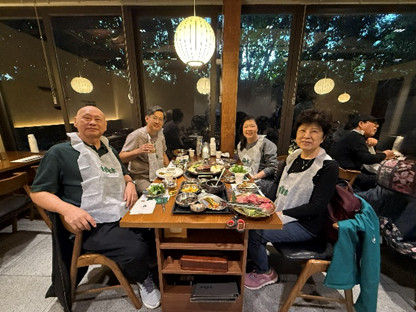
My son Shen-Yang and his partner Ai Huey had been invited to speak at a medical conference in Jeju, and he asked if we would like to join them to tour the island.

We flew in on 31 October.

For the first two days, they were completely tied up with their conference commitments. We set aside the following three days to explore Jeju together.

I had rented a car to drive around the island. I was pleasantly surprised that they were willing to let a 76-year-old man take the wheel — provided I had an international driving licence. (Shen-Yang was too busy to apply for one.) Getting it from the Road Transport Department at its Petaling Jaya office was as easy as a walk in the park.

Koreans drive on the right side of the road, and I had never handled a left-hand-drive car in my life. So, I was a little apprehensive at first. The airport sits on the northern coast, while our hotel — Lotte Hotel Jeju — is on the opposite side of the island. The drive took about an hour. It turned out to be not difficult at all. Saw Hwa was an excellent navigator.

During the first two days, we drove aimlessly along the western coast — knowing full well that once Ai Huey was free, she would have all the proper sightseeing spots lined up. Still, we did manage to visit a Buddhist temple which, like most in Korea, exuded a quiet spiritual gravitas.

We also went to the city’s wet market and enjoyed the finger food there.

I am not good at remembering places, but I believe we covered much of the island in the last three days when all four of us travelled together. However, I simply could not recall the places we had visited on our previous trip — taken perhaps 20 years ago. I remember a spot where the tour guide demonstrated a David Copperfield–like illusion: our coach appeared to be going downhill when it was actually climbing uphill. I also recall visiting a well-known drama prop-village, whose owner proudly told us she had acted in the show.

Jeju is an island born of volcanic eruptions, and many of its attractions revolve around this geological heritage. We also took a ferry to visit Go Island. “Go” means “cattle” (, Niú — if you speak Minnan, you’ll notice how close many Korean words can sound to Minnan). But we didn’t see any cattle there; we saw only a few horses. There wasn’t much to see on the island. The buggy we hired to circle the place was a rip-off — though we rented it with eyes wide open.

(I have always felt that, out of a sense of national pride, both Korea and Vietnam have largely abandoned the use of Chinese characters in their writing systems. A purely phonetic script certainly has its merits, but in these two cases it also means losing the original meaning and deeper roots of many words. As a result, many Koreans and Vietnamese today may not fully understand the foundations or meanings of their own names—names that their parents had often chosen with great care—unless they also know some Chinese.

To me, this kind of nationalism feels somewhat misplaced. At the same time, we Chinese must also recognise that many of our neighbours view us with a degree of discomfort, if not hostility. That sentiment, too, is part of the reality we have to acknowledge.)

Jeju is about 2½ times the size of Singapore, but it has no MRT. The roads are good but not particularly enjoyable to drive on. The top speed is 80 km/h, and many stretches are capped at 50. There are numerous child-protection zones with a strict 30 km/h limit. Cameras are everywhere. As much as I tried to comply, I suspect I may have exceeded the limit a few times.

We also sampled some of Jeju’s signature restaurants. The food was generally good — though not particularly great.


My son remarked that my driving was solid! Not bad for a 76-year-old!

That is enough of Jeju for now.

End

Whoosh – the High-Speed Rail between Jakarta and Bandung


I had a function to attend in Bandung. I’d been there before, but that was by driving from Kuningan, Jakarta, where I lived temporarily for a couple of months. Bandung was – and perhaps still is – the shopping capital of Indonesia. When my wife’s relatives from Kuala Lumpur visited, I took advantage of my company-provided car and drove them there. They must have enjoyed the trip.

Back then, there were direct flights from Kuala Lumpur to Bandung, operated by AirAsia. This time, online information initially suggested that the route was still active, with multiple flights available. Unfortunately, all of that turned out to be outdated – there are now no direct flights between the two cities

I therefore had to travel via Jakarta: Kuala Lumpur to Soekarno–Hatta International Airport on Malaysia Airlines, then a cab to Halim Station for the China-built high-speed rail (HSR) to its Tegalluar terminus. From there, a courtesy feeder train took me to Bandung Station, where I booked a Grab ride to my hotel, the Four Points by Sheraton.

My wife had warned me about the negative comments circulating online about the HSR, mostly concerning connectivity – the distance from Soekarno–Hatta to Halim, and the distance from Tegalluar to central Bandung. ChatGPT also flagged similar issues.

So, I gave myself plenty of buffer time in both Jakarta and Bandung. In the end, the trip turned out better than expected – though not without a few observations that left me unsure about certain aspects of the service.

The HSR has a wonderful, punchy name: Whoosh. I love it.

However, booking tickets online was tricky. To begin with, I didn’t know the train’s official name was Whoosh. The first link that appeared in my Google search was Rail.Ninja. It looked legitimate, so I booked a set of return tickets through them.

When I arrived at Halim and tried to enter the turnstile, I realised instantly that I had been “conned.” The payment confirmation email contained no barcode to scan. The security guard had never seen such a document before. Fortunately, passenger traffic was light, and a helpful lady officer escorted me to the lounge (I had booked Business Class). She returned shortly with two genuine return tickets – at prices much lower than what I had paid Rail.Ninja. I had been overcharged by a third-party reseller.

(If I had simply checked Whoosh’s official site – ticket.kcic.co.id – I could have avoided the indignity of being fooled by a pretender. I should have learned my lesson; years ago, I was similarly misled by a third-party website when applying for a Canadian visa!)

The train itself was spotless. It departed on time, and the ride was smooth. We reached a maximum speed of 348 km/h. My colleague CD Liang, who travelled earlier, told me his train hit around 380 km/h. Passengers were also given a small pack containing bottled water and some tidbits.

A law lecturer from Medan was sitting next to me. He spoke little English, but I know “pasar” Malay, which is close to Bahasa Indonesia, so we managed well enough. He was extremely thoughtful. Seeing me with a walking cane, he fussed about trying to help. He was genuine, though my luggage was light and I could walk steadily. He took a selfie of us and exchanged cards; before I even reached Bandung, he had whatsapped me. I promised to look him up the next time I visit Medan, which I do from time to time.

Upon arrival, passengers were directed to a feeder line heading downtown. I had no idea where to alight, but CD Liang had reminded me to get off at the second stop. The signage, I must say, could be more foreigner-friendly.

Grab fares around town were inexpensive – about 40,000 IDR, or roughly SGD 4.

For my return journey, I upgraded myself to First Class out of curiosity. It shares the same carriage as Business Class but is partitioned for extra luxury. I was the only passenger in the compartment.

HSR tickets are not expensive. There has been a great deal of negative commentary about this project, much of it, I suspect, because it was financed and built by China. Western media commonly portray it as part of China’s so-called “debt trap.” Yes, the service does not appear financially viable if judged purely on costs and immediate revenue. But its broader economic and social benefits should not be overlooked. That said, these accusations may have made Indonesia somewhat sensitive or hesitant – perhaps explaining why the service feels a little “shy-to-show” to the outside world.

End