Sunday, March 12, 2023

New Book, Knowing Your Roots - Chapters 1 and 2

 I am embarking on a new book. It is meant to be a compendium for ethnic Chinese. 

It is still very much a work in progress. There are about 20 chapters - in about 200 pages. 

I list out all the dynasties, eras, etc - from Huang-di about 5,000 years ago to Xi's China today. And in the chapters for each of these dynasties and eras I insert information that I think may be of interest to non-experts - about beliefs, festivals, classics, wisdom from certain idioms, art, culture and traditions. I hope ethnic Chinese will take pride of their roots.

I look forward to friends' and readers' support on this effort of time! I will be posting the chapters on this blog of mine on a regular basis. (Maybe only one or two chapters a week to prevent any syndrome of readership fatigue. I welcome all forms of feedback. Please privately message me at yubooklim@gmail.com if you have any.

The first two chapters are as follows:


Chapter 1

Huang-di 黃帝 and Before


Credit: https://commons.wikimedia.org/w/index.php?curid=60794173


Early evidence of millet agriculture in the Yellow River basin was carbonated to about 9,000 years ago and cultivated rice in the Yangtze River basin some 1,000 years later. With agriculture came an increased population. Pigs and dogs were the earliest domesticated animals in the region, and after about 5,000 ago domesticated cattle and sheep arrived from Western Asia.

Bronze artifacts (between 3100 and 2700 BC) have been found in the upper Yellow River region in eastern Gansu.

 The Xia (夏) and the Shang (商) are perhaps the earliest most definitive dynasties in Chinese history but before that there must be also organised societies of Huang-di descendants. Legend has it that China was already under a very enlightened leader called Huang-di (黃帝, the Yellow Emperor – Huang[1] is yellow and di means emperor) some five thousand years ago (2697/8–2597/8 BC).

Huang-di is a deity (神 – shen) figure to Chinese. He is still being worshipped as the originator of the Chinese civilisation and ruler of a centralized Chinese state. Several texts – such as the Huang-di Nei Jing (黄帝内经) a medical classic, and the Huang-di Si Jing (黄帝四经), a set of political treatises – were attributed to him. To this day the Yellow Emperor remains a powerful symbol of Chinese nationalism.


Chapter 2


Early Dynasties – Xia and Shang

Xia夏朝 [2100-1600 BC]/Shang 商朝; [1600-1100 BC]


Left: Xia, Right: Shang

 After Huang-di, legends list Yü [禹], Yao [堯], Shuen [舜], Fu Hsi [伏羲] and Shén Nóng [神农] [2]as five of China’s subsequent leaders; they are generally credited with controlling floods which often devastated agrarian livelihoods in the Yellow River basin of that era. 

In a way the character 夏 (Xia, pin-yin Xià), preceded and taken together with another character 华 (Hua, pinyin Huá), i.e., 华夏 – Hua Xia – represents Chinese as a race – with a common cultural ancestry – by the various confederations of the pre-Qin China.

After Xia, it was Shang (商). Like Xia, Shang’s history is hazy; however, the dynasty did leave archeological evidence about its existence. The most famous of which are the oracle bones – the earliest known form of Chinese writing inscribed onto animal bones and turtle shells for divinations. Major discoveries have been made in the city of Anyang (安阳 in Henan), which is believed to be the last capital city of the Shang. Over 20,000 pieces of Chinese writing were discovered. Tens of thousands of artefacts, many of which were in bronze, were unearthed and the workmanship displayed demonstrates it was a highly civilized society. (Given this fact, obviously, the writing had been developed earlier.)


It is said that last Shang King, Xin (辛), was defeated in battle by King Wu of Zhou (周武王), forcing the Shang king to commit suicide. His son was kept on by King WU to rule Shang as a puppet leader.

Archaeologists have unearthed a large number of artefacts in a finding called San Xing Dui (三星堆) in Central China (Sichuan). There was indeed a parallel bronze-age civilisation then; however, it had mysteriously vanished.


Written Chinese (中文, Zhōng Wén)


Chinese is one of the oldest continually used writing systems still in use. The characters themselves are often composed of parts that may represent physical objects, abstract notions, or pronunciation. Literacy requires the memorization of a great number of characters: college-educated Chinese speakers should know about 4,000. 


Various current Chinese characters have been traced back to the late Shang dynasty, but the process of creating characters is thought to have begun some centuries earlier. After a period of variation and evolution, Chinese characters were standardized under the Qin dynasty (221–206 BC).


Because of its geography, pronunciations develop into unintelligible local varieties, but all are able to communicate through its writing. It was not until the early 20th century that Classical Chinese was replaced by vernacular Chinese.


Chinese characters were extensively used in Korea, Japan and Vietnam until nationalism crept in to replace them.


Chinese characters are developed on six basic principles. The first two principles produce simple characters, known as 文 wén:


1.     Pictographs (象形 xiàng xíng), in which the character is a graphical depiction of the object it denotes. Examples: 人 rén "person" (from  to 人), 日 rì "sun", and 木 mù "tree/wood". And the evolution of 馬/马 (horse, mǎ) is depicted below:


2.     Ideographs (指事 zhǐ shì), in which the character represents an abstract notion. Examples: 上 shàng "up", 下 xià "down", 三 sān "three".


The remaining four principles produce complex characters historically called 字 zì (although this term is now generally used to refer to all characters, whether simple or complex). Of these four, two construct characters from simpler parts:


3.     Logical Aggregates (会意 huì yì), in which two or more parts or characters are used to construct a composite character to illustrate a concept. E.g., “east” in Chinese is 東, which is made up of two characters 日 (Sun) and 木 (tree). The Sun rises amongst the trees. From where? East, of course. Hence 東, However, 東has now been simplified to 东!


4.     Phonetic Complexes (形聲/形声 xíng shēng), in which one part denotes the general essence of the character (such as water-related or eye-related), and the other part of the character is used for its phonetic value. Example: 晴 qíng "clear/fair (weather)", which is composed of 日 rì "sun", and 青 qīng "blue/green", which is used for its pronunciation.

In contrast to the popular conception of Chinese as a primarily pictographic or ideographic language, the vast majority of Chinese characters (about 95%) are constructed as either logical aggregates or phonetic complexes. 

The last two principles do not produce new written forms; instead, they transfer new meanings to existing forms:


5.     Transference (转注 zhuǎn zhù), in which a character, often with a simple, concrete meaning takes on an extended, more abstract meaning. Example: 網/网 wǎng "net", which was originally a pictograph depicting a fishing net. Over time, it has taken on an extended meaning, covering any kind of lattice, or even to a computer network.


6.     Adaptation or Borrowed Form (假借 jiǎ jiè), in which a character is used, either intentionally or accidentally, for some entirely different purpose. Example: 哥 gē "older brother", which is written with a character originally meaning "song/sing" 歌 gē. There was no character for "older brother", so an otherwise unrelated character with the right pronunciation was borrowed for that meaning.

Chinese characters are written to fit into a square, even when composed of two simpler forms written side-by-side or top-to-bottom. In such cases, each form is compressed to fit the entire character into a square.

                                                                                Source: Wikipedia


Chinese Surnames. Xing (姓 Xìng)


Han-Chinese are believed to be the first people to use surnames. The earliest surnames might be matrilineal, but Han Chinese family names have been patrilineal for millennia, passing from father to children. Prior to the Warring States period (fifth century BC), only the ruling families and the aristocratic elite had surnames.


Chinese view their surnames as part of their shared kinship and Han identity. Chinese are exogamous and they are supposed to refrain from marrying those with the same family name. (Koreans, which follow many traditional Chinese practices, are most diligent on this practice.


Married women used Shi (氏) to denote their maiden origin.


Around 2,000 Han Chinese surnames are currently in use.  19 surnames are used by around half of the Han Chinese people, while 100 surnames are used by around 87% of the population. Wang  (王)  and Li (李), Zhang (张), Liu (刘), Chen (陳), Yang (杨), Huang (黃), Zhao (赵), Wu (吳) and Zhou (周). Many non-Han Chinese have adopted such surnames.

 
Another point to note: Chinese surnames come before given names.


The San Xing Dui (三星堆) Discovery

 The San Xing Dui (Three Star mounds or piles) discovery puts paid to the belief that the Yellow River basin was the sole cradle of Chinese civilisation. The artefacts that have been unearthed in Guanghan (广汉), Sichuan are carbon-dated to be from the twelfth to eleventh centuries BC (or more than three thousand years ago) which makes its civilisation contemporaneous to that of Shang dynasty’s, which was a Bronze Age culture. Chinese archaeologists believe that it belonged to the ancient kingdom of Shu 蜀 (not the Shu of the Three Kingdoms period. Geographically, however, they were in the same Sichuan plain, which spread across the upper reaches of the Yangtze River).

References to the existence of a Shu kingdom that may be dated reliably to such an early period in Chinese historical records are scant. The kingdom is mentioned in Shi Ji (史記) and Shu Jing (书经) as an ally of the Zhou who defeated the Shang. The Shu Kingdom was founded by Can Cong (蠶叢) who was described as having protruding eyes, a feature that is found in many of the masks and figures of San Xing Dui. It has therefore been suggested that the large masks with protruding eyes are a representation of Can Cong, but that is just an interpretation.


Bronze objects found included sculptures of humans, bells, axes and animals such as dragons, snakes, and birds. Other were made of gold or carved out of jades. There was also a large number of ivory and clam shells. The most striking finds were dozens of large bronze masks and heads that carried angular human features with exaggerated almond-shaped eyes and protruding pupils, and large upper ears. Researchers were astonished to find an artistic style that was completely unknown in the history of Chinese art.

The San Xing Dui culture is indeed a mysterious civilization. The culture had certainly developed a different method of bronze-making from that of Shang’s. It is also clear that it was quite an advanced one as well.

The large number of seashells excavated at the ruins came from the Indian Ocean, meaning that they must have been transported from ancient India. 

But it vanished out of thin air after this. Was there a huge natural disaster, like an earthquake that befell them? But what had happened to the bodies of the victims? No traces have remained.


Mid-Autumn Festival (中秋节 Zhōng Qiū Jié )

(The 15th Day of the 8th Moon)


Also known as the Moon Festival or Mooncake Festival, its history dates back over 3,000 years (Shang Dynasty). It is held on the 15th day of the 8th moon in the Lunar calendar.


Lanterns of all sizes and shapes are carried and displayed. They are symbolic beacons that light people's path to prosperity and good fortune. Mooncakes typically filled with sweet-bean, egg yolk, meat or lotus-seed paste are traditionally prepared for this festival.


The Mid-Autumn Festival is based on the legend of Chang’e (more correctly Chang Er?), the Moon goddess in Chinese mythology. The story was about a hero named Hou Yi (后羿) who was an excellent archer and his wife Chang'e. One year, ten suns rose in the sky together, causing great disaster to the people. Hou Yi shot down nine of the suns and left only one to provide light. An immortal admired Hou Yi and sent him the elixir of immortality. Hou Yi let Chang’e keep it, for he did not want to be immortalized alone. However, Peng Meng, one of his apprentices, knew this secret. On the 15th day of an 8th moon, when Hou Yi went hunting, Peng Meng broke into Hou Yi's house and wanted Chang'e to give the elixir to him. Chang'e refused. She swallowed it and it made her fly into the sky. As she loved her husband, she chose the moon – which was nearest to the Earth then – as home, instead of the faraway stars.


Hou Yi was devastated. On the 15th day of every 8th moon, he could see the silhouette or grainy image of Chang’e with her jade rabbit clearly on the surface of the Moon. He would bring out her favourite cake to offer her.


Soon Chang’e became the “goddess” of the Moon and the custom of praying to the Moon on Mid-Autumn Day has been handed down for thousands of years since then.


But there is yet another version: After Hou Yi shot down nine of the ten suns, he was pronounced king by the thankful people. However, he soon became conceited and tyrannical. Wanting to have an eternal life, he asked for the elixir from Xi Wang-mu (Queen Mother of the Heavenly West). But his wife, Chang'e, kept it because she did not want Hou Yi to live long and hurt more people. Hou Yi became angry when he discovered that Chang'e had taken the elixir, he shot at his wife as she flee to the moon but missed. People were touched, and that day – the 15th day of the 8th moon – was commemorated.


Legends, legends, legends…


Today Chang’e is China’s space programme that sends missions to the Moon. Its Jade Rabbit (Yùtù-2 – 玉兔二号) is still roving on the dark side of the moon.


[1] Huang may not be his surname. Yellow River or Huang He is the cradle of Chinese civilisation. He is simply being revered as the Father of Huang or Yellow civilisation.

[2] Again, none of these names might be surnames. Surnames came later.


Wednesday, February 8, 2023

The West’s Paranoia Knows No Bounds

I have not been blogging for the last couple of weeks. My daughter and her family came from Melbourne to spend a couple of days in Malaysia. My wife and I took them and our son and his family for a holiday in Langkawi. We had a good time there. Then a disaster struck, we had borrowed my brother-in-law’s 7-seater Volvo XC90 to go around. I thought I should give you a wash before I returned it to him. In the car wash outlet which I usually patronise, I promptly crashed it! Then came the Lunar New Year. There were so many get-togethers to attend. And in flew Hwa’s second sister and her husband from Melbourne. They are putting with us for their week-long holiday here.

On the geopolitical front, America was telling everyone that Antony Blinken was going to visit Beijing in early February, even though China had not quite bothered to confirm. Then came the balloon incident!

All hell is breaking loose!

We know it had been shot down by a USAF F-22 fighter, just before it drifted out of the eastern coastline of the United States.

To the lunatic Biden, Blinken and Austin, the appearance of the balloon was a violation of America’s sovereignty. It is a perfect excuse for them to heighten Americans’ paranoia about RED China!

Days before the incident, the US is already trying to provoke China by successfully persuading the Netherlands not to sell ASML machines to China, even though the Dutch government had just a day or two said they would make their own decision on the matter. The US detained Chinese zinc products from Xinjiang (again on Human Rights concern!!!) and decided to sell more more offensive weapons to Taiwan – all just before Blinken was to visit Beijing.

Why do you need such a spy balloon, said to be 200 feet tall and visible to naked eyes, when your BeiDou?

America is simply spoiling for a fight!

Of course, you also have the conspiracy theory in that China had deliberately sent it to make a statement to America. I personally do not believe in this theory. Xi Jinping is simply too noble for such an antic.

But as I have always contended, Chinese are very poor in international Public Relations. They should have from the very outset announce this to the world: One of our weather and scientific research (people do not know what it means; they need to explain) has drifted off-course and my fly over your territory. Kindly take note. Period. Ditto on the one that has drifted to South America.

I love to use Chinese idioms to describe the low level of intellectuality you are seeing in America’s politicians today.

The first idiom that came to my mind is this: 杯弓蛇影, 草木皆兵 (Bēi-gōng-shé-yǐng, Cǎo-mù-jiē-bīng) – cup’s bow looks like snake’s shadow, tall grass and trees are all soldiers. People are becoming so paranoid that they see threats and dangers everywhere!

The other pertinent idiom for this case is 小题大做 (Xiǎo-tí-dà-zuò) – Small topic, big do, or making a mountain out of a molehill.

If you have an agenda against someone, you will take every opportunity, no matter how silly or irrelevant, to accuse him or her. This is a perfect example!

Fortunately, most people are not that stupid.

Wednesday, January 18, 2023

Another Sham Project?

I bought a condominium unit at Saujana Resort in 2009 – basically for me and my wife to stay whenever we were in town, since we called Melbourne home at one time.

In the early 1990s, I was once a member of the golf club there under a corporate account. But I remember I have only visited the club house once. Apart from that, I did not know much about the precinct.

The unit suited me well – Subang Airport, which Firefly uses, is only five minutes away. And it would be all swift too if I had to fly from KLIA, except for the traffic light just at the exit of the suburb. However, this stretch of Subang Road is a nightmare to cover during peak hours.

The resort hides some of the most handsome homes in the Klang Valley. You will find all sorts of upmarket cars on Persiaran Golf, which many outsiders also use for their weekend morning walks.

My wife is finding Melbourne’s cold months uncomfortable. We have decided to return to Malaysia for good.

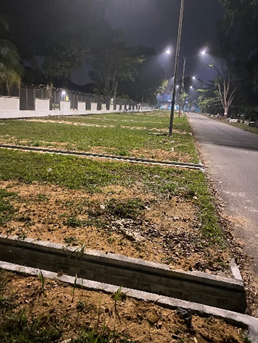
This is what we are seeing in a stretch of Persiaran Golf now:


What are these people doing?

Persiaran Golf is a double carriageway, except for this stretch of the road. Suddenly, drains are being erected every twenty steps of so. What are they for? The area has, as far as I know, never experienced any flood problem.

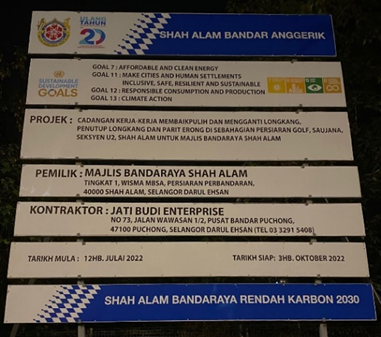
I consulted the signboard:


Yes, they are constructing the drains. Yes, that stretch of the road does not appear to have drain-offs. But why so many drains?

The completion date is supposed to be 3rd October 2022. Today is 16th January 2023, yet much of the work has yet to be completed. It is a big eyesore!

On what basis was the design done? Certainly not much on engineering principles.

Probably the way for someone to do rent seeking?

Talking about rent-seeking, I have a friend who reluctantly accepted a civil engineering contract from a politically connected party. Upon completion, he submitted a claim for RM11 million, giving him a happy margin of about RM3 million. He later found that the party was paid more than RM30 million for “the” project. The rent-seeking portions three times the true cost of the project!!!

Corruption and rent-seeking have gone outlandish! No wonder there are so many Alphards and Vellfires with all sorts of fanciful plates around!

Prime Minister Anwar Ibrahim has just disclosed that the country’s national debt stands at a staggering figure of RM1.2 trillion. With other liabilities added, the total is about RM1.5 trillion! How much of these two figures are a result of corruption and rent-seeking practices?

Hope the unity government is doing something lest we may soon become the No 1 in the world’s Rent-Seeking Championship table.

Monday, January 16, 2023

Zhao Li-jian Has Been Reassigned!

Zhao Li-jian has been reassigned as the deputy director of the Boundary and Ocean Affairs Department of China’s Ministry of Foreign Affairs. He has served as the ministry’s spokesperson for many years. Many friends are going to miss Zhao.

I hope this is a promotion for him. But I suspect it is not. Maybe with the new foreign minister, Zhao is deemed a baggage. 

Zhao had often been a source of my arguments with friends when we discussed China. I have always cited Zhao as an example of China’s inadequacy in international relations. To me, his demeanours when fielding questions are the type of China-bashing reporters love to see about Chinese officials – mean, harsh, too sharp, patronising, unsmiling, Communistic, someone who – in their own imagination – personifies the fictional character Fu Manchu, and what-have-you. To them, Zhao is China’s foremost wolf-warrior amongst its MoFA spokespersons.

Zhao postulated that corona virus was Fort Detrick’s creation and brought into China by the American soldiers when attended the 2019 Military World Games in Wuhan in October. On Xinjiang, he bluntly said to the pro-West media that they were “cooking false information and reiterated that “China has no genocide, Period.” And this is what he has to say on Five Eyes: No matter if they have five eyes or ten eyes, if they dare to harm China’s sovereignty, security, and development interests, they should beware that their eyes would be poked. He also created an uproar with Australia’s Morrison government by posting an image of an Australian soldier holding a bloodied knife against the throat of an Afghan child. (Apparently, the image was originally created by a Chinese political cartoonist in response to the publication of the Brereton Report, which had been released by the Australian government earlier that month – to own up to the war crimes that had been committed by the Australian Defence Force during the Afghan war between 2005 and 2016. The cases include the throat-slitting of two 14-year-old Afghan boys and the subsequent cover-up by the Australian military.)

Being “western” in my concept of what public relations ought to me, I naturally took a dislike of his style as well. But having seen how the pro-West wordsmiths have behaved, I now think China should have more wolf-warriors like Zhao. But the approach needs refining.

Pro-West reporters are beholden to their vested-interest publishers to demonise China whenever and wherever possible. Few bothers about truth. Feeding frenzy is the order of the day. The vicious circle usually takes this form: Someone would come up with some ill-founded stuff. It does not matter whether it is true or false. You quote the source and add some condiments (to claim authorship, of course), and another will add some ketchup here and there. When the “news” reaches the original author, he or she will exclaim: There you are; it is a fact! Reporters and journalists are at best wordsmiths, but many have assumed that they are the authority for one to count on for facts and opinions. How silly!

What should the approach be?

Apply what the West is best at: The Art of Pre-emption.

Most of these reporters are lazy. They gather in press conferences to do daydreaming much of the time.

The stuff that they gather at China MoFA’s press conferences is usually perfect for them to distort things in or about China – especially if the spokesperson is aggressive and defensive, a style which Zhao tended to adopt.

In fact, before a press conference is held, the MoFA should already know what issues reporters will likely ask. The following are just some examples and what preparations should be made to pre-empt these reporters.

On the removal of COVID-19 restrictions…

China might have created for themselves a perfect storm out of its kneah-su (Singapore Fujianese term, meaning afraid to lose) culture. Virus does not care whether you are rich or poor, or democracy or autocracy. It will spread like wildfire if you are not prepared. Their three years of exemplarily handling the virus has gone to waste. There is nothing wrong in removing the draconian restrictions; as a matter of fact, China should have opened up a couple of months earlier. Unfortunately, the bureaucrats were too afraid to look bad – just in case anything untoward should happen during the 20th Party Congress. But they failed to bear in mind one big cultural weakness in Chinese – kneah-si (Singapore Hokkien, meaning afraid to die), and hence their tendency to rush to hospitals and hoard medicine on the first sign of infection, even they were just suffering from mild fevers and scratchy throats. There is enough herd immunity in the populace, except amongst the elderly rural folks. These should have been prepared for that, especially many old people were very reluctant to get vaccinated all this while.

Only after 60,000 have died (not to be unexpected with China's population base), mostly elderly people, have they started to own up. Again, their approach was defensive in essence. Their defensiveness has allowed Western and pro-West press and channels to have a field day, since many videos did confirm the mayhem in many parts of the country.

What Chinese spokespersons should have done is to own up early. We are also humans; we also make mistakes at times! And show the world that China cares!

With their organizing ability, containing this Omicron round should be just a walk in the park for them. Instead, they have become a source of “there you are” ridicules. There is a Chinese idiom (大智若愚 dà zhì ruò yú – brilliant, but acting like a fool), but this time around, I am going to twist it slightly as 大智是愚 dà zhì shi yú – brilliant but indeed stupid, this time at least!)

On COVID-19’s origin, the majority in the West continues to believe it originated in Wuhan. But having heard so many so-called experts, I dare say nobody can say for certain where it actually began. But with what has been exposed in the US-funded laboratories in Ukraine and what Prof Jeffrey Sachs has written in Lancet, I am inclined to point my finger at the US. What China should do is to equip these published materials and make them readily available at the conference room. Just ask the journalists to read them each time a question of this nature is raised.

On Japan’s attitude and actions towards China…

Kishida is visiting the G7 countries. He is telling them how good it is for the G7 to work with Japan to contain China. Japan’s aggression and its soldiers atrocities are all well documented – the Mukden incident, the Rape of Nanjing, the bombing of Pearl Harbor and Darwin, the abuses of British and Commonwealth soldiers after their surrender in Singapore, the killing of countless Chinese in Malaya and Singapore, the pain that was inflicted to MacArthur’s in the Philippines, comfort women in Korea, China and else, and many many others.

It should also not forget to keep reminding the world of Japan’s decision to dump tonnes of nuclear-contaminated water from its Fukushima nuclear plant into the Pacific Ocean!

All the spokespersons must do is again to hand out OBJECTIVELY compiled documents to the reporters and ask this question: Can you trust the Japanese? Period.

Again, there is a Chinese saying: the more you add water, the more to-fu you get. Do not waste time answering them!

On the China-India boarder conflict…

Indian historian A S Bhasin has authored a definitive book called Nehru, Tibet and China on the history of this China-India conflict. Again, Chinese MoF should equip with a generous number of copies of this book to be complimentary extended to reporters or journalists when they ask about this matter. It should seal their mouths in no time.

On Taiwan...
Again, make the reporters and journalists aware of the true character of Lee Teng Hui, Chen Shui-bian, and Tsai Ing-wen, especially on Tsai’s questionable PhD thesis and her father less-than-honourable wealth accumulated in Japan-controlled Northeast and historical materials on Qing Hui or Qin Kuai [秦桧], Wang Jing-wei [汪精衞] and Wu San-gui [吳三桂] and let them know if treasons can be tolerated in their own society.

On the US’s ban on chips and chip-making technology to China…

Too much has already been reported on this. The US has clearly violated WTO’s most basic principle, i.e., the right of Free Trade. MoFA should just keep documenting and updating the US’s actions and make them available each time a question is asked. Let the world see how hypocritical the US is!

On South China Sea…

There was a report saying that Indonesia had to send a warship to shadow a Chinese coast guard vessel which seemed to be prowling in the former’s exclusive economic zone. China must not be too complacent about its neighbours. It should keep its neighbours informed of the activities of its naval and coast guard vessels in the area. Indonesians are a very sensitive lot. Jokowi has shown a great amount of goodwill to Xi. China must reciprocate!


Conclusion

In China’s press conferences, I suspect questions are often planted and answers are read from prepared scripts. And when fielding questions from foreign reporters, spokespersons tend to regurgitate the official lines. They can be very tiring to hear.

China is a poor student in International Public Relations Lesson 101, i.e., The Art of Pre-Emption. It should learn from the West the way to beat them in their own game!

Saturday, January 14, 2023

Do Away with Firing Squads but Bring Back the Big Cane!


ABS gave this Chinese “spy” headlines in November 2019. 60 Minutes Australia also gave him a big microphone. Today, the truth – to Australian authorities – is out and Wang Li-qiang has been refused asylum in Australia!

It takes the Australian authorities four years to know the “truth”, when every Chinese Tom, Dick and Harry knows Wang is a fraudster.

Wang indulged in self-aggrandization and claimed he helped China to undermine Hong Kong protest movement. He claimed he was a key person in China’s espionage network. He even incriminated several people in Taiwan. He decided he had had enough of a bad China; it was time for him to do good, hence his asylum application when he had the opportunity to be in Australia. He would tell Australia all the murders and tortures China had committed!

The Western media love Wang’s type of tall tales. They make good headlines. More importantly, they make China look evil! They throw away their professionalism and reproduce every rubbish that poured out from these fraudsters’ mouths.

The truth is, fraudsters like Wang are in deep shit in China and are desperately looking to have a new lease of life in countries like the US, Australia, or Canada. Claiming that they will face personal danger if they return to China because they have out of conscience “betrayed” China, or they have regretted in partaking in China’s “evil” deeds, is the easiest way to gain asylum from the not very discerning authorities in some of these countries. Apparently, some have also been successful with their dubious claims of being persecuted for their religious or ethnic causes. After getting their new passport, they dare even to re-enter China with their Chinese passports. But things are changing. China has recently decided to “kill” their Chinese passports upon arrival. They are now no longer Chinese citizens.

People like Wang deserves the harshest punishment. In China, facing a firing squad is usually the way to go. Personally, I am against death sentences. I understand China has already started to practise suspended death sentences unless the crime is totally heinous. Giving people like Wang 24 strokes of cane, like what Singapore usually does to serious criminals, is the best way to deter other Wang-like characters to demonise China and Chinese.

Coming back to treasons and treacheries…

Qing Hui of Qin Kuai [秦桧] (19090-1155) is perhaps the best-known traitor in Chinese history. He was a prime minister during the Song dynasty. He was instrumental in the execution of Yue Fei [岳飛] who fought against the Jurchen marauders.


There are several well-known traitors in Chinese history and their treasons are well-documented. In this article, I would just like to recall a few:

Wang Jing-wei [汪精衞] 

Wang (4 May 1883 – 10 November 1944) was initially a champion of Chinese nationalism. He was a close associate of Sun Yat-Sen. After Sun’s death, Wang unsuccessfully engaged in a political struggle with Chiang Kai-Shek for control of the Kuomintang. Upon the outbreak of the Second Sin-Japanese War in 1937, he collaborated with the Japanese to form a puppet government in Nanjing and served as the head of state of this government. Chinese regard Wang as a Qing Hui in modern Chinese history.

Historian Dr Stephen Leong Mun Yoon, in a speech during the launching of his book Sources, Agencies and Manifestations of Overseas Chinese Nationalism in Malaya, 1937-1941, explained that Wang was driven by the reality of the day. China was a wrecked country then; the only way to survive, in Wang’s opinion, was to accept Japan’s overlordship. In 1644, Ming general Wu San-gui [吳三桂] also opened the gate of Shanhaiguan to the Manchu invaders to establish the Qing dynasty. China stagnated thereafter!

This brings me to the second traitor in modern Chinese history: President Tsai Ing-wen of Taiwan. 

Tsai Ing-wen

We all know Tsai is openly inviting the US to support her Taiwan Independence cause. She might help turn Taiwan into another Ukraine for the US in Western Pacific. What the US wants is clear for all to see. Most Chinese outside Taiwan just cannot understand why Tsai would want to go down in history as the Qin Hui of the 21st Century.

Honorary Traitors,,,

Several others can rank equal with Qin Hui, but they are no longer Chinese citizens. But culturally, they still claim kinship with Chinese. They should be made “honorary” traitors – people like Miles Yu Mao-chun, Katherine Tai, and the likes of them.